You’ve seen the classic photo: Machu Picchu’s terraces and ruins with Huayna Picchu rising behind.
But the most powerful view isn’t of the city—it’s from the entrance the Incas themselves used.
High above the crowds, a mountain gateway reveals why this wonder was built and how it was experienced.
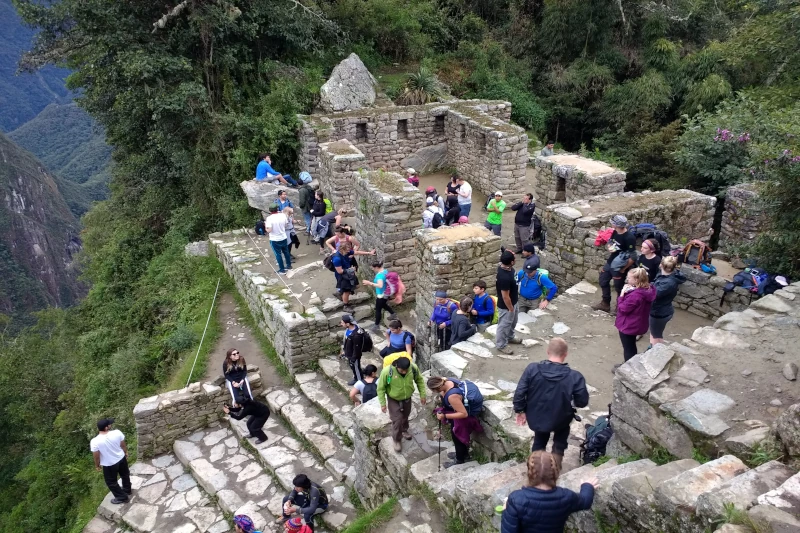
This gateway is Inti Punku, Quechua for “Sun Gate,” the original entrance for travelers completing the Inca Trail.Pilgrims finished their pilgrimage with a final climb to this mountaintop checkpoint instead of arriving by bus.From its elevated perch, the entire citadel unfolds in a dramatic panorama—a reveal that most tourists completely miss.
Inti Punku was more than a viewpoint. It served as both a ceremonial gateway and a strategic checkpoint.Its location allowed Inca guards to monitor visitors and control access, ensuring only approved people entered the sacred grounds.The Sun Gate aligned with the sun, linking its function to both the people and Inca ceremonial traditions.

More than a photo spot, Inti Punku was the grand entrance for travelers completing the Inca Trail.
Arriving at the Sun Gate after a long climb was a moment of deep significance.Passing through its stone frame, the entire citadel of Machu Picchu unfolded below in full glory.
Inti Punku was more than ceremonial. It also acted as a formal entryway and a high-security checkpoint. Its strategic location on the mountain ridge gave Inca guards a perfect vantage point.
From here, they could monitor who approached and control access to the sacred grounds.
This dual role made Inti Punku a transition point between the outside world and Machu Picchu.
Its most remarkable function was connected not to the people, but to the sun itself.The Sun Gate aligned with the sun, marking important ceremonial moments for the Incas.
The structure earns its name in the most spectacular way. Each year, on the morning of the June solstice the winter solstice in Peru. As the sun rises over the distant mountains, its first golden rays shine directly through the main window of the gate, flooding the Inca Trail trek with light. This perfect alignment is no accident. It was a deliberate and masterful feat of engineering designed to capture the sun on its most important day.
This celestial event held a profound spiritual meaning because the Incas worshipped the sun as their principal god, Inti. As the divine ancestor of the Inca emperors and the giver of light, warmth, and life, Inti was central to their entire world. The winter solstice marked a moment of great hope. It was the day the sun began its journey back. It promises longer days and ensuring the survival of their crops and their empire.
Inti Punku, therefore, was more than a gate. It was a massive celestial clock and a sacred instrument built to honor their god. By precisely marking this crucial solar event, the Incas reaffirmed their divine connection to the cosmos and demonstrated their understanding of astronomy. For them, Inti Punku at Machu Picchu wasn’t just marking a place on a map. It was marking a sacred moment in time, proving that Inti was still watching over his people.
While the classic postcard photo of Machu Picchu is breathtaking, it’s taken from within the citadel itself. The view from the Sun Gate viewpoint is entirely different. From this higher elevation, you look down upon the entire complex like an architect studying a masterpiece. This top-down, panoramic perspective is the only way to truly appreciate the city’s masterful layout. In fact how every temple, terrace, and plaza fits perfectly into the surrounding mountain landscape. It answers the question, “How did they build this here?”
This vantage point is also the legendary “first glimpse”, the exact view that awaited weary travelers at the end of the Inca Trail. Standing here. You can capture that iconic arrival photo. The lost city nestled between the sharp peak of Huayna Picchu and the broader Machu Picchu Mountain. It’s a powerful image that tells a story of discovery. The citadel in its dramatic Andean context in a way no other lookout can.
Beyond the stonework, the view from Inti Punku reveals a secret hidden from the main site: the powerful Urubamba River. From this high perch, you can trace its silver path as it snakes around the base of the mountains, the very force that carved this sacred valley. Seeing the city, the peaks, and the river all in one frame provides a complete picture that helps to understand. This unparalleled view is the ultimate reward for the journey to get there.
Now that you know what an incredible view awaits, you might be wondering: just how hard is it to get there? The good news is that the Sun Gate trail is considered a moderate hike, accessible to most people with a decent level of fitness. Forget technical rock scrambling or clinging to ropes; think of it as a steady, uphill walk along an ancient stone path. The trail is well-maintained and follows a section of the classic Inca Trail, making every step feel like part of history.
From the main urban sector of Machu Picchu, the hike to the top takes most visitors about 90 minutes. The path involves a consistent elevation gain, meaning you’ll be walking uphill almost the entire way. While it can be tiring, especially given the altitude, it’s not a steep or punishing climb. The key is to take your time, drink plenty of water, and pause to admire the Machu Picchu views as you ascend. The total round trip, including time to rest and take photos at the top, usually takes about 2.5 to 3 hours.
Best of all, this incredible experience is one of the “free hikes” included within the Machu Picchu grounds. You don’t need to buy a separate, expensive permit just for Inti Punku. Unlike the more famous Huayna Picchu or Machu Picchu Mountain climbs. However, access to the trailhead does depend entirely on the main citadel entry ticket you purchase. This makes planning your visit crucial to ensure you don’t miss out.
While the Sun Gate is a celebrated “free hike inside the citadel,” access isn’t automatic with every ticket.Machu Picchu manages foot traffic using pre-set routes called circuits. To reach the Sun Gate trailhead, you must buy a ticket for the upper terraces, usually Circuit 3 or a combined Machu Picchu Mountain ticket.
When booking online, select one of these options carefully.A general entry ticket for lower circuits won’t allow access to the trail.Planning ahead ensures you can experience the full Sun Gate hike without issues.
Timing is key to enjoying the ascent.Start early, ideally between 7:00 and 9:00 AM, when the sun is lower and the air cooler.An early start helps your body acclimate to altitude and avoids the hottest hours, making the hike more enjoyable.
A little preparation goes a long way in turning a good hike into a great one. The trail is exposed to the elements, so packing smart is essential.
Choosing between the Sun Gate and the Huayna Picchu hike is a classic Machu Picchu dilemma. Both offer unforgettable views, but they deliver vastly different experiences. The Sun Gate offers a historical, panoramic perspective. While Huayna Picchu is a thrilling, adrenaline-fueled climb to a bird’s-eye viewpoint. Your choice depends entirely on your fitness level, comfort with heights, and what you want to feel when you look out over the city.
The journey to the Sun Gate is a true hike a gradual, 90-minute walk up a wide, stone-paved path. While it’s consistently uphill and a good workout, the Sun Gate trail difficulty is moderate and the path is not exposed, making it ideal for most visitors, including families and those with a fear of heights. In stark contrast, Huayna Picchu is a much shorter but far more strenuous climb up narrow, steep stone steps, often called the “stairs of death.” It requires a strong head for heights and a good level of fitness.
From a planning perspective, the two are worlds apart. The Sun Gate trail is accessible with specific general admission circuits and doesn’t require a separate reservation, offering great flexibility. Huayna Picchu, however, is a different story. Access is strictly limited and requires a special Machu Picchu ticket that often sells out three to six months in advance. If you haven’t planned far ahead, the decision is often made for you.
Ultimately, the best hike comes down to the view you want to earn. The Sun Gate provides the classic, wide-angle shot of the entire citadel from a distance, letting you see it as Inca travelers did for the first time. Huayna Picchu gives you an incredible top-down view, looking directly into the city’s layout. One is a grand, sweeping reveal; the other is a unique, almost aerial inspection.
Before, Machu Picchu might have been just one iconic photograph. Now, you understand its true entrance a gateway designed not just for people, but for the sun itself. You can see Inti Punku not as a ruin on a distant hill, but as the opening chapter to the city’s story, a celestial clock and a guardhouse rolled into one. This new knowledge transforms a simple viewpoint into a meaningful destination.
So, is the Sun Gate hike worth it? For its blend of stunning views, historical connection. The sheer sense of accomplishment, the answer for most travelers is a resounding yes. It offers a deeper appreciation for Inti Punku and Machu Picchu that you simply cannot get from the citadel floor.
Knowing how to hike to the Sun Gate makes it an easy and unforgettable addition to your trip. The key is to prepare properly. First, give your body at least two days to acclimatize to the altitude in Cusco or the Sacred Valley. Then, ensure you book the correct Machu Picchu tour circuit ticket online well in advance.
With those steps handled, all that’s left is to pack a Machu Picchu day trip bag with water, snacks, and sun protection. Remember to go at your own pace on the trail; this isn’t a race. The journey to stand where Inca travelers first laid eyes on their sacred city is an experience that will stay with you long after you’ve returned home.
WhatsApp us